
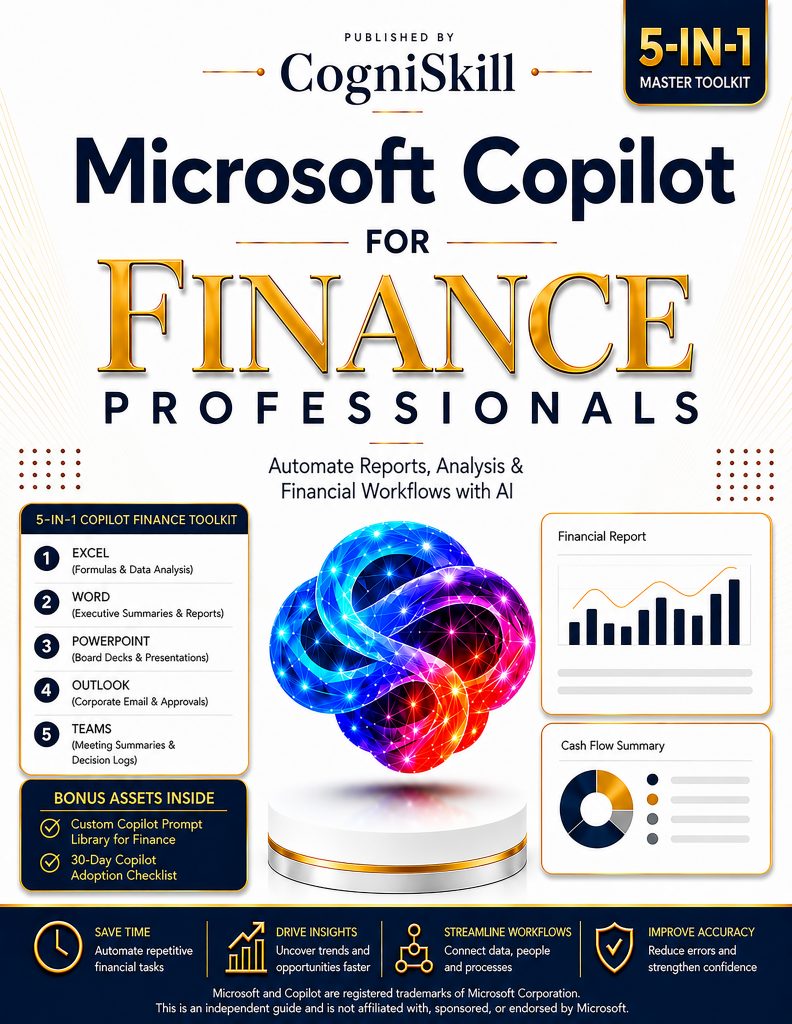
Microsoft Copilot for Finance Professionals: Automate Reports, Analysis & Financial Workflows with AI: 5-in-1 Master Toolkit
Microsoft Copilot for Finance Professionals is a practical, business-focused book for finance teams that want to use Microsoft Copilot with discipline, confidence, and measurable value. Instead of treating AI as a shortcut or a generic productivity…
""Transform financial expertise into AI-powered productivity with Microsoft Copilot.""
What You Will Learn
About This Book
Microsoft Copilot for Finance Professionals is a practical, business-focused book for finance teams that want to use Microsoft Copilot with discipline, confidence, and measurable value. Instead of treating AI as a shortcut or a generic productivity tool, this book shows finance professionals how to use Copilot as a responsible assistant for everyday finance work: drafting management commentary, summarizing financial information, improving stakeholder communication, preparing executive-ready narratives, supporting variance analysis, strengthening forecast discussions, and creating better finance workflows across Microsoft 365.
Designed for modern finance professionals, FP&A teams, controllers, accountants, analysts, finance business partners, and leaders, the book focuses on the real work of finance—not abstract AI theory. Readers learn how to prompt Copilot effectively, validate outputs, separate facts from assumptions, protect sensitive information, and keep human judgment at the center of financial decision-making.
What You’ll Learn
- How to use Copilot in real finance workflows: Apply Microsoft Copilot to reporting, analysis, forecasting, variance commentary, month-end close communication, stakeholder updates, and executive updates.
- How to write better finance prompts: Create clear, structured prompts that define the audience, objective, source material, assumptions, format, and review expectations.
- How to work faster while protecting accuracy: Use AI-assisted drafting and summarization without losing control over validation, confidentiality, materiality, and professional judgment.
- How to turn financial information into clearer business communication: Translate data, results, risks, and forecast changes into concise narratives that help leaders understand what happened, why it matters, and what to do next.
- How to improve variance analysis and commentary: Use Copilot to structure explanations around drivers, trends, risks, business context, and recommended follow-up questions.
- How to strengthen forecasting discussions: Prepare clearer forecast narratives, summarize key assumptions, identify risks and opportunities, and explain changes from prior outlooks.
- How to support month-end close communication: Draft cleaner status updates, issue summaries, close commentary, and stakeholder messages while maintaining review discipline.
- How to review AI-generated finance work: Check outputs for source support, formulas, assumptions, missing context, confidentiality, approvals, and decision usefulness.
- How to separate facts from assumptions: Identify confirmed information, possible interpretations, open questions, and areas that require additional validation.
- How to apply Copilot across Microsoft 365: Use Copilot-supported workflows across Excel, Word, PowerPoint, Outlook, Teams, and finance-related documents and communications.
- How to build repeatable finance AI habits: Use practical patterns, checklists, review questions, and prompt structures that can be reused across finance cycles.
- How to adopt AI responsibly in finance: Keep human judgment, accountability, confidentiality, transparency, and professional standards at the center of AI-assisted work.
Why This Book Matters
Finance teams are under pressure to move faster, explain results more clearly, improve forecast accuracy, reduce manual rework, and communicate insights to executives with greater confidence. Microsoft Copilot can help—but only when finance professionals know how to use it responsibly. This book bridges that gap by turning Copilot into a structured finance productivity system rather than a collection of random prompts.
Readers will discover how to use AI-assisted finance workflows while maintaining accountability, review controls, confidentiality, source validation, and professional standards. The result is a book that helps finance teams save time without sacrificing accuracy, judgment, or trust.
- Move faster without sacrificing accuracy.
- Improve finance communication for executives and stakeholders.
- Adopt AI with stronger controls, review, and accountability.
Key Features
- Finance-specific Copilot guidance: Learn how to apply Microsoft Copilot to finance activities such as variance analysis, management reporting, forecasting commentary, month-end close communication, stakeholder updates, and executive presentations.
- Practical prompt engineering for finance: Build stronger prompts with clear objectives, audience context, reporting periods, source boundaries, materiality thresholds, output formats, assumptions, and review requirements.
- Responsible AI workflows: Understand how to use Copilot without transferring accountability away from finance professionals. The book emphasizes validation, review, confidentiality, approval controls, and human judgment.
- Microsoft 365 productivity focus: Apply Copilot across familiar finance tools and workspaces such as Excel, Word, PowerPoint, Outlook, Teams, and finance-related documents.
- Executive-ready communication: Turn financial data and analysis into clearer summaries, business narratives, variance explanations, forecast implications, and decision-ready messages.
- Reusable frameworks and checklists: Use practical scorecards, workflow patterns, review questions, and prompt structures that can be adapted to real finance tasks.
- Designed for business users: Written for finance professionals, not developers. The book focuses on practical adoption, communication, analysis, controls, and productivity.
- Supports modern finance transformation: Helps finance teams move from manual drafting and repetitive communication to structured, AI-assisted workflows with stronger review discipline.
Who This Book Is For
This book is ideal for finance professionals who want to use Microsoft Copilot in a practical, responsible, and business-ready way. It is especially valuable for:
- FP&A analysts and managers
- Finance business partners
- Controllers and accounting leaders
- Corporate finance teams
- Financial analysts and reporting analysts
- Budgeting and forecasting professionals
- Month-end close and management reporting teams
- CFO office teams and finance transformation leaders
- Consultants supporting Microsoft 365, AI adoption, or finance productivity initiatives
- Business leaders who want clearer finance communication and better AI-assisted workflows
Best suited for: finance professionals who want practical AI adoption—not generic theory, hype, or technical complexity.
Why This Guide Stands Out
Microsoft Copilot for Finance Professionals gives readers more than a basic introduction to AI. It provides a practical operating guide for using Copilot in real finance work. The book helps readers move beyond generic AI experimentation and toward repeatable, reviewable, finance-specific workflows that support better communication, faster drafting, stronger analysis, and more confident decision support.
For individuals, it can help build practical AI fluency and improve daily productivity. For finance teams, it can support consistent prompting practices, better review habits, clearer reporting, and more responsible adoption of Microsoft Copilot. For organizations, it offers a useful foundation for finance AI enablement, training, process improvement, and digital transformation.
Topics Covered
This guide explores the practical ways Microsoft Copilot can support finance professionals in everyday work, from FP&A, forecasting, variance analysis, and management reporting to executive communication, responsible AI practices, finance prompt engineering, and broader finance transformation across Microsoft 365.
In One Sentence
Microsoft Copilot for Finance Professionals is a practical guide to using Microsoft Copilot for financial reporting, FP&A, forecasting, variance analysis, executive communication, prompt engineering, and responsible AI workflows in modern finance teams.
Frequently Asked Questions
Who is this book written for?
This book is written for finance professionals who want to use Microsoft Copilot in practical, responsible, and business-ready ways. It is especially useful for FP&A teams, finance business partners, controllers, accountants, reporting analysts, budgeting and forecasting professionals, and finance leaders.
Do I need technical or coding experience?
No. The book is designed for business and finance users, not developers. It focuses on practical workflows, finance communication, prompt writing, review habits, and everyday Microsoft 365 Copilot use cases.
What finance tasks does the book cover?
The book covers AI-assisted finance work such as management reporting, variance analysis, forecasting commentary, executive updates, stakeholder communication, month-end close support, prompt engineering, review controls, and responsible use of Copilot across finance workflows.
Does the book focus only on Excel?
No. While Excel is important for finance work, this book takes a broader Microsoft 365 view. It shows how Copilot can support finance professionals across Excel, Word, PowerPoint, Outlook, Teams, and finance-related documents and communications.
How does this book help with responsible AI use?
The book emphasizes that Copilot should support—not replace—professional judgment. Readers learn to review outputs, validate source support, check assumptions, protect confidential information, identify missing context, and apply human oversight before using AI-assisted work in finance decisions or communications.
Will this book help my finance team adopt Copilot more consistently?
Yes. The book provides repeatable patterns, prompt structures, review questions, and workflow ideas that can help teams build more consistent habits around Copilot use. It can support training, enablement, finance transformation, and more disciplined AI adoption.
Is this book useful for finance leaders?
Yes. Finance leaders can use the book to understand where Copilot can improve productivity, communication, reporting quality, and team workflows. It also helps leaders think about review standards, accountability, adoption practices, and responsible AI governance in finance.
What makes this book different from a general AI guide?
This book is focused on finance work. It connects Copilot to the tasks finance professionals perform every day, including reporting, analysis, forecasting, commentary, stakeholder updates, and executive communication. The emphasis is on practical use, review discipline, and business value—not generic AI theory.
Glossary of Key Terms
Microsoft Copilot: An AI-powered assistant in Microsoft 365 that helps users draft, summarize, analyze, organize, and communicate information across familiar tools such as Excel, Word, PowerPoint, Outlook, and Teams.
Microsoft 365 Copilot: The Copilot experience across Microsoft 365 apps, designed to help users work with documents, spreadsheets, presentations, emails, meetings, and organizational content.
AI-Assisted Finance Workflow: A finance process where AI helps with tasks such as drafting commentary, summarizing information, structuring analysis, preparing updates, or improving communication, while the finance professional remains accountable for review and final judgment.
FP&A: Financial Planning and Analysis, the finance function focused on budgeting, forecasting, performance reporting, business analysis, and decision support.
Prompt Engineering: The practice of writing clear, structured instructions for AI tools so they produce more useful, accurate, and relevant responses.
Finance Prompt: A prompt designed for finance work that includes context such as audience, reporting period, source material, assumptions, level of detail, tone, format, and review requirements.
Variance Analysis: The process of comparing actual financial results with budget, forecast, prior period, or target values to explain what changed, why it changed, and what it means for the business.
Forecasting Commentary: Written explanation that describes expected financial performance, key assumptions, risks, opportunities, and changes from prior forecasts.
Management Reporting: Internal reporting that helps leaders understand business performance, financial results, trends, risks, and decisions that may require action.
Executive-Ready Communication: Clear, concise, decision-focused writing that presents financial insights in a way senior leaders can quickly understand and act on.
Responsible AI: The disciplined use of AI with attention to accuracy, confidentiality, transparency, fairness, review, accountability, and appropriate human oversight.
Human-in-the-Loop Review: A review process where a person checks AI-generated work before it is used, shared, or relied on for decisions.
Source Validation: The process of confirming that AI-generated statements, summaries, or conclusions are supported by reliable source information.
Materiality: The significance of a financial item, variance, risk, or assumption in relation to business decisions, reporting requirements, or stakeholder attention.
Finance Transformation: The improvement of finance processes, tools, data, reporting, operating models, and capabilities to help finance teams deliver better insight, efficiency, and business value.
Decision Support: Finance work that helps leaders evaluate options, understand risks and trade-offs, and make better business decisions.
Start Using Copilot with Confidence
Bring practical AI into your finance work with confidence. Whether you are preparing financial commentary, improving forecast discussions, summarizing meetings, drafting executive updates, or building stronger finance workflows, Microsoft Copilot for Finance Professionals gives you the guidance, prompts, controls, and practical examples needed to use Copilot responsibly and effectively.
Start using Microsoft Copilot as a smarter finance assistant—not a replacement for judgment, but a powerful partner for clearer, faster, and more disciplined finance work.
Microsoft, Microsoft 365, Microsoft Copilot, Excel, Word, PowerPoint, Outlook, and Teams are trademarks or registered trademarks of Microsoft Corporation. This book is an independent guide and is not affiliated with, sponsored by, or endorsed by Microsoft Corporation.
Table of Contents
Chapter 1: Why Finance Work Is Changing Now
Explains how growing demands for speed, insight, and decision support are transforming finance work, and how Copilot can help reduce manual effort while preserving financial controls and professional judgment.
Chapter 2: What Copilot Can and Cannot Do for Finance Professionals
Defines the strengths and limitations of Copilot, helping finance professionals understand where AI can assist and where human expertise, review, and accountability remain essential.
Chapter 3: The Finance Copilot Mindset: From Manual Work to Managed AI Assistance
Introduces a practical framework for using Copilot responsibly by combining clear objectives, strong prompts, quality data, critical review, and finance ownership.
Chapter 4: Copilot in Excel: Analysis, Formulas, Tables, and Variance Explanations
Demonstrates how to use Copilot in Excel for data analysis, formula creation, variance reviews, financial modeling support, and insight generation while maintaining data accuracy.
Chapter 5: Copilot in Outlook: Faster Financial Emails, Approvals, and Follow-Ups
Shows how Copilot can streamline financial communication through email drafting, thread summaries, approval requests, stakeholder updates, and follow-up management.
Chapter 6: Copilot in Teams: Meeting Summaries, Action Items, and Finance Collaboration
Explains how to capture meeting insights, decisions, risks, and action items more effectively using Copilot in Teams to improve collaboration and accountability.
Chapter 7: Copilot in Word and PowerPoint: Reports, Narratives, and Executive Presentations
Focuses on transforming financial analysis into reports, executive summaries, narratives, and presentations that support leadership decision-making.
Chapter 8: Monthly Reporting and Management Packs
Covers the creation of management reports and monthly performance packs, including executive summaries, KPI reviews, risk highlights, and decision-oriented reporting.
Chapter 9: Variance Analysis and Financial Commentary
Teaches how to identify meaningful variances, investigate root causes, develop evidence-based explanations, and write stronger financial commentary.
Chapter 10: Budgeting and Forecast Preparation
Explores how Copilot can support budgeting cycles, forecast development, assumption gathering, scenario planning, and stakeholder coordination.
Chapter 11: Cash Flow, Working Capital, and Scenario Analysis
Shows how AI can help analyze liquidity, cash flow drivers, working capital performance, and alternative business scenarios to support financial planning.
Chapter 12: Month-End Close, Reconciliations, and Audit Readiness
Examines how Copilot can assist with close activities, reconciliations, documentation, audit preparation, and controls while maintaining compliance standards.
Chapter 13: Turning Numbers into Stories for Executives
Focuses on converting complex financial data into clear business narratives that executives can quickly understand and act upon.
Chapter 14: Building Board-Ready Presentations with Copilot
Provides techniques for creating concise, strategic, and decision-focused board presentations using Copilot-assisted workflows.
Chapter 15: Explaining Finance to Non-Finance Stakeholders
Teaches finance professionals how to communicate financial information clearly and effectively to business leaders and stakeholders without financial expertise.
Chapter 16: Accuracy, Review, Risk Controls, and Scaling Copilot Across Finance
Discusses governance, validation, risk management, review processes, and best practices for expanding Copilot adoption across finance teams.
Chapter 17: Prompt Engineering for Finance Professionals
Provides practical methods for designing effective prompts that generate more accurate, relevant, and usable financial outputs from Copilot.
Chapter 18: The Future Finance Professional: Working Smarter with Copilot
Explores how AI is reshaping finance careers and how professionals can develop skills that combine financial expertise with AI-assisted productivity.
Appendix A: Copilot Use Cases by Finance Role and Sector
Offers role-specific and industry-specific examples showing how different finance professionals can apply Copilot in their daily work.
Appendix B: Finance Prompt Library
Provides a collection of reusable prompts designed for common finance tasks, reporting workflows, analysis, communication, and decision support.
Appendix C: 30-Day Copilot Adoption Checklist
Presents a structured plan for helping finance professionals build Copilot habits, workflows, and governance practices over a 30-day period.
Conclusion: The AI-Powered Finance Professional
Summarizes the book’s core lessons and reinforces how finance professionals can use Copilot responsibly to increase efficiency, insight, and business impact.
Key Features & Included Resources
Related Exam Guides & Workbooks
Cybersecurity
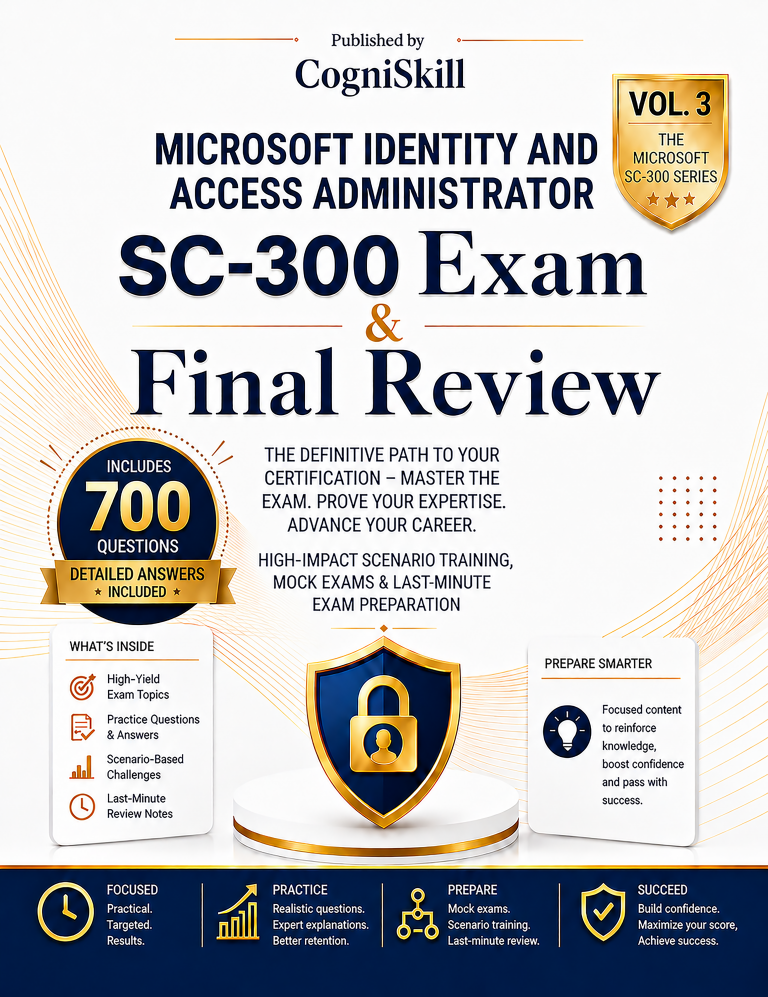
SC-300 Microsoft Identity and Access Administrator Exam Cram & Final Review: 700 Advanced Questions, High-Impact Scenario Drills, and Last-Minute … Exam (Entra ID P1/P2 & Governance)
SC-300 Study Guide: Microsoft Identity and Access Administrator Certification Guide About the Book Are you ready to become…
Cybersecurity
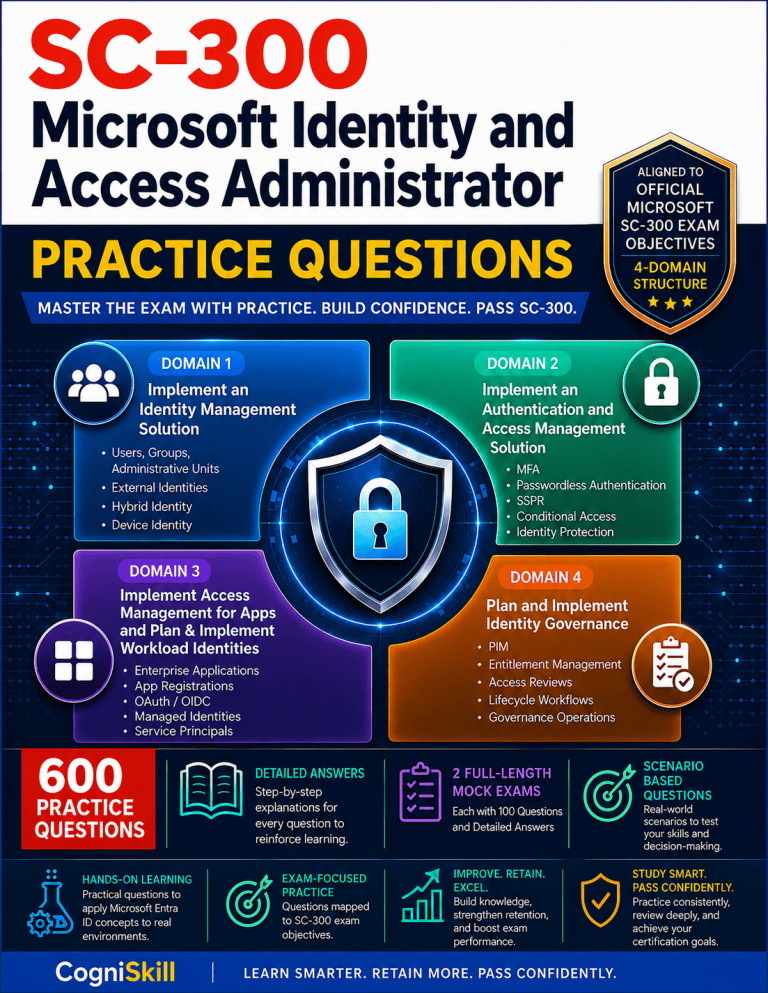
SC-300 Microsoft Identity and Access Administrator – The Ultimate Exam Prep & Practice Workbook: 600 Questions, Scenario Deep Dives, and Two Mock Exams
In the modern enterprise, the traditional corporate firewall is dead. The new security perimeter is Identity. Whether a…
Cybersecurity
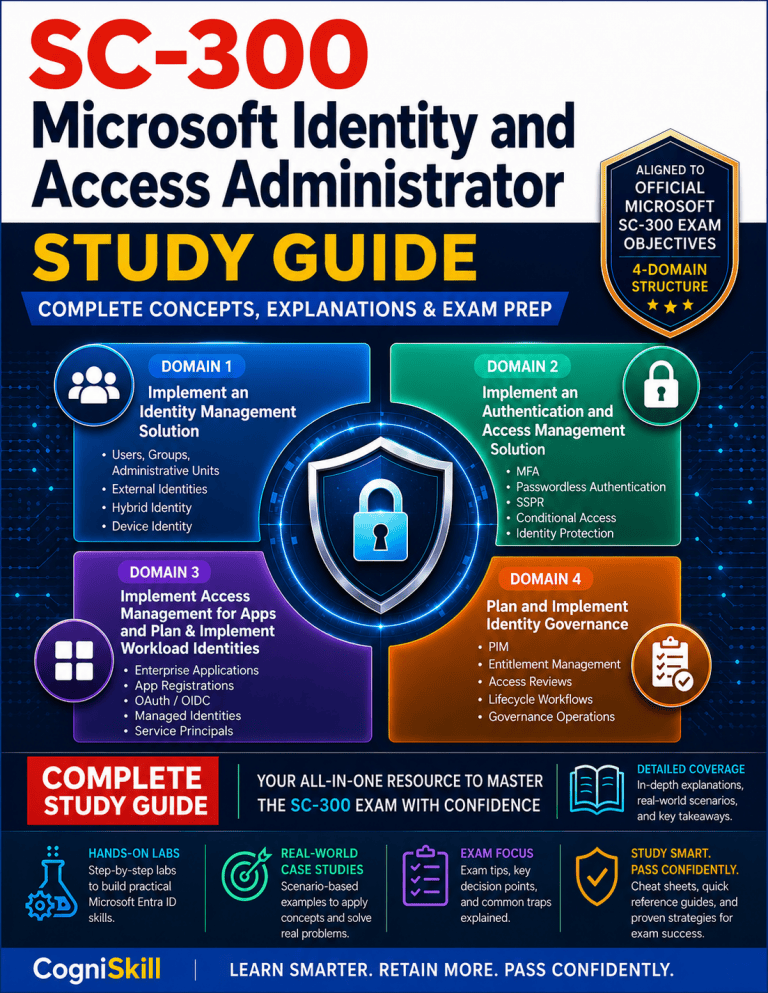
SC-300 Study Guide for Microsoft Identity and Access Administrator Exam Prep: Comprehensive Theory, Real-World Labs, and Full Objective Coverage for Microsoft Entra ID
Master the SC-300 exam with comprehensive theory, real-world labs, and full coverage of Microsoft Entra ID identity and…