
LESSON 1 OF 4
An endpoint contract comes before a module command
Your practical task
Build a paginated Graph-style report that detects loops and keeps a failed collection separate from a complete empty result.
You need a user inventory, not permission to change accounts. First shape a supplied sample object locally; then design the optional Graph access. The core exercise requires no tenant and stores no tokens.
How the system works
An API page is not the whole dataset. A next-link indicates more data, and its full URL is part of the service’s paging contract. Treating the first page as complete can produce a convincing but incomplete access or inventory report. In this offline lab the page URLs are keys in a fixture, so you can practise traversal without a tenant or access token.
Pagination also needs a termination rule. If a next-link repeats, a naïve loop can run forever. The HashSet records visited page keys and stops when a key appears twice. That is a collection failure, not permission to return whatever happened to be collected before the loop. Production code should preserve a partial result only when the report explicitly marks it incomplete.
Read-only permissions still need least privilege and approved use. The permission required depends on the endpoint, delegated or application context, and the properties you request. A working sample is not proof that broad directory permissions are necessary. For a live extension, select the exact documented endpoint, review its permission table and token context, and avoid placing tokens in logs or exported CSV files.
An endpoint contract comes before a module command
For a Microsoft Graph request, identify resource path, operation, access mode, required permission and expected response shape. Installing the SDK does not grant authorization. Delegated and application access are different contexts; a user sign-in in a browser is not evidence for an unattended collector.
This course's fixture simulates Graph-shaped pages. It deliberately avoids tenant access, credentials and consent. Use it to learn control flow and failure handling before adapting a collector to a documented endpoint. Record collection scope so a later report does not treat a filtered result as an organization-wide inventory.
Reasoning model
An API report is complete only when every required page has been retrieved successfully under a known filter and permission scope. A successful first response is not a complete inventory. Follow the service-provided continuation mechanism rather than reconstructing offsets. A retry loop needs bounds and must distinguish transient throttling from persistent authorization failure. Record completion state so a partial report cannot masquerade as an empty or final inventory.
COGNISKILL BOOKS
Go deeper with a related book
This short course practises a focused skill. Related CogniSkill books offer an optional longer learning and preparation path; this course does not claim full exam coverage.
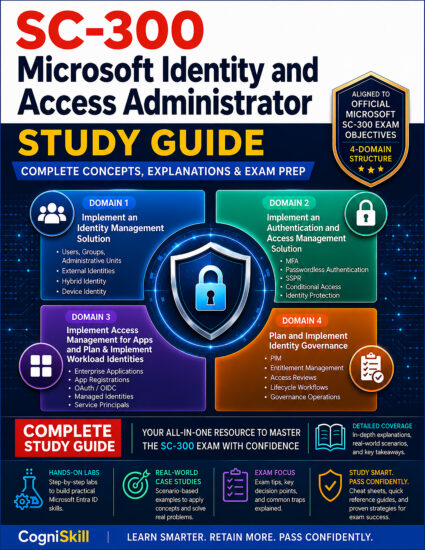
SC-300 Microsoft Identity and Access Administrator — Study Guide
For building a structured understanding of the subject.
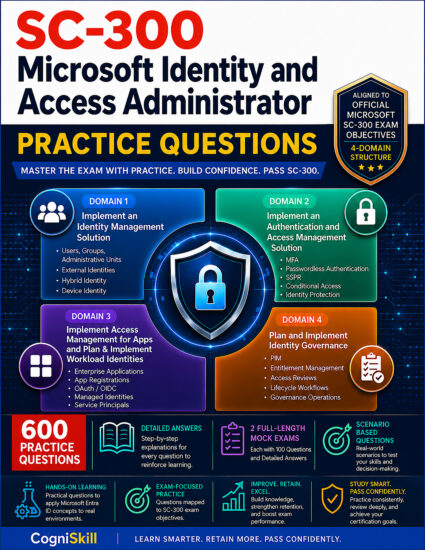
SC-300: Microsoft Identity and Access Administrator — Practice Questions
For working through questions and practical scenarios.
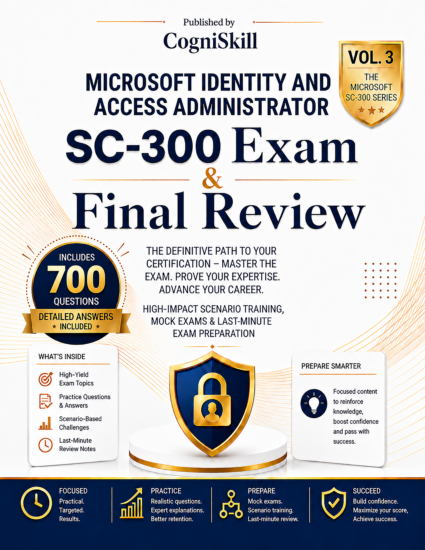
SC-300 Microsoft Identity and Access Administrator — Exam Cram & Final Review
For focused revision after you have studied the subject.
Sign in to save lesson completion. Reading position is separate from completion.
Practice notes — your working space
Save predictions, outputs and explanations as you work. Notes stay on this browser, not your account; people sharing this browser can access them. Avoid passwords and sensitive data. Export to keep a portable copy, or clear your notes before leaving a shared device.
How was this lesson?
Help us improve this lesson.