
LESSON 4 OF 4
Collector acceptance tests
Build your project
Add page count and completeness metadata to the fixture collector. Test an empty successful result, two pages, a missing second page and a repeated next-link. Write a separate live-integration plan naming endpoint, permission model, retry limit and export fields; do not add real credentials.
What a complete result looks like
Pagination completeness is explicit
The two offline pages produce IDs 1 and 2 exactly once. Test a valid empty page, a missing collection property and a repeated next link separately. The live-design appendix records the supported endpoint permission, token audience, next-link handling, bounded retry policy and secret redaction. The offline run establishes pagination behavior only; it does not establish that a Microsoft tenant granted the required permission.
Acceptance criteria
- Local and live steps distinguished
- Permissions justified
- Pagination checked
- No tokens retained
Self-review record
Record your inputs, expected and actual outputs, failing test, correction, and remaining limitation. A reviewer should be able to reproduce your conclusion from your evidence. Compare your result with the lab baseline; explain any deliberate extension rather than simply copying its output.
Retrieval practice
Answer in your own words before opening each explanation. Use an example from the fixture to justify your answer.
Why follow a next-link?
Compare your reasoning
It identifies the next page in the response contract; the first page may be incomplete.
Is a forbidden response equivalent to zero users?
Compare your reasoning
No. It is failed authorization and tells you nothing about the count of users.
Why test offline fixtures first?
Compare your reasoning
They make pagination, empty results and failure handling reproducible before permissions and network variability are introduced.
Collector acceptance tests
Exercise a normal chain, terminal empty result, missing page, repeated link, malformed item and bounded-retry exhaustion. Define a stable identity and reject contradictory duplicates under your chosen contract. Distinguish “collected zero items completely” from “collected nothing because authentication failed.”
Deliver the scope, endpoint/version plan, permission justification, sanitized error references and collection status. A production adapter also needs secret handling and redirect/destination review. The learner project remains offline unless an explicitly authorized tenant lab is separately arranged; no live Graph execution is claimed by these fixtures.
Transfer project — changed conditions
Implement a mock page-fetch function and test normal pagination, a repeated next link, retry exhaustion and a duplicated user across pages. Decide whether the report needs unique identities or raw records and document your deduplication key. Add a permission review showing the exact read operation and the least-privilege documented authorization for the chosen mode. Keep secrets and raw tokens out of logs.
Practical assessment rubric
Score each dimension 0–2: 0 = absent or materially incorrect; 1 = partly correct with an unresolved gap; 2 = correct, explicit and supported by the supplied evidence or an actual labeled lab result.
- Evidence/model: identify the relevant entities, inputs, assumptions and boundaries without inventing facts.
- Main result: derive the case-specific expected result, calculation or decision and show the intermediate reasoning.
- Failure/boundary: test the changed condition and explain why the original conclusion does or does not transfer.
- Verification: supply reproducible steps and expected/observed results; label manual traces as manual, not executed.
- Communication/safety: explain limitations, owners and a proportionate next action without unsafe or unnecessary access.
Target: at least 8/10, with no zero in main result or communication/safety. This is a local learning rubric, not an accredited certification standard. A written/manual solution demonstrates reasoning only; operational competence additionally requires the relevant executable lab in an authorized environment. The native multiple-choice score is separate and does not automatically grade this rubric.
Submission template
- My input/evidence and assumptions:
- Expected result with calculations or trace:
- My implementation/decision and justification:
- Changed-condition result:
- Observed execution, or explicitly labeled manual trace:
- Failure and recovery evidence:
- Unverified limitation and next action:
- Self-score with evidence for each dimension:
Remediation
If the main result is wrong, reconstruct the supplied case from the raw inputs before changing code or controls. If the boundary case is wrong, identify the assumption that changed and rerun both the original and changed case. If verification is missing, do not convert a prediction into an observed result. Reattempt the transfer task without copying the worked solution, then explain it to another person.
Official reference for further study
Assessment: explain your decisions
Choose an answer and write your reason before opening each explanation. Then explain why the other choices do not fit the evidence. Use missed questions to revisit the lesson. This knowledge check is only one part of assessment: complete the practical transfer project as well. It does not predict certification-exam success.
1. Which permission direction fits basic inventory?
- Documented minimum read access
- Directory-wide write by default
- A copied admin token
Answer and explanation
Documented minimum read access — Read requirements should be matched to minimum permissions.
2. Does one successful response establish complete inventory?
- Always
- No; pagination and scope matter
- Only if formatted
Answer and explanation
No; pagination and scope matter — API paging can limit the returned set.
3. Which should be excluded from debug logs?
- Row count
- Error category
- Raw access token
Answer and explanation
Raw access token — Raw tokens are credentials.
4. A Graph-shaped page is empty but has a supported nextLink. Is collection necessarily complete?
- No; follow the paging contract
- Yes, empty always means end
- Yes, if the first request succeeded
Answer and explanation
No; follow the paging contract — The continuation contract, not the page’s row count alone, determines completion. Endpoint-specific behavior must be respected.
5. A required Retry-After exceeds this job’s budget. What should it do?
- Publish the first page as the entire directory
- Defer or report incomplete rather than retry too early or claim completeness
- Ignore the delay
Answer and explanation
Defer or report incomplete rather than retry too early or claim completeness — Respect throttling and collection limits. A truncated population must not become a false complete inventory.
6. The next page repeats a previously visited link. What should the fixture do?
- Silently declare completion
- Repeat forever until the service changes
- Stop with an explicit loop error
Answer and explanation
Stop with an explicit loop error — A repeat is a failed pagination contract in this fixture. Neither infinite work nor fabricated completeness is appropriate.
7. When can the fixture report be labeled complete?
- After N3 succeeds and supplies no continuation.
- After the first HTTP success.
- As soon as two users are displayed.
Answer and explanation
After N3 succeeds and supplies no continuation. — Completion depends on traversing the entire continuation chain, not merely receiving a successful page.
8. What is the expected unique-user count?
- Four because throttling discards page 2.
- Five.
- Two.
Answer and explanation
Five. — After the bounded retry succeeds, all three pages contribute U1 through U5.
9. Retries exhaust at N2. What should the report say?
- All users: two.
- No users exist.
- Partial/incomplete with the error and collected rows clearly identified.
Answer and explanation
Partial/incomplete with the error and collected rows clearly identified. — An interrupted inventory cannot support either a complete count or a claim of absence.
Open the scored course assessment to use the existing practice-test engine. Earlier attempts remain part of your history.
Optional deeper study
If you want a longer learning path, inspect the related CogniSkill SC-300 books in the existing book panel. Choose by the book’s actual scope and edition. The exercises, downloads and answers in this course are complete without purchase.
COGNISKILL BOOKS
Go deeper with a related book
This short course practises a focused skill. Related CogniSkill books offer an optional longer learning and preparation path; this course does not claim full exam coverage.
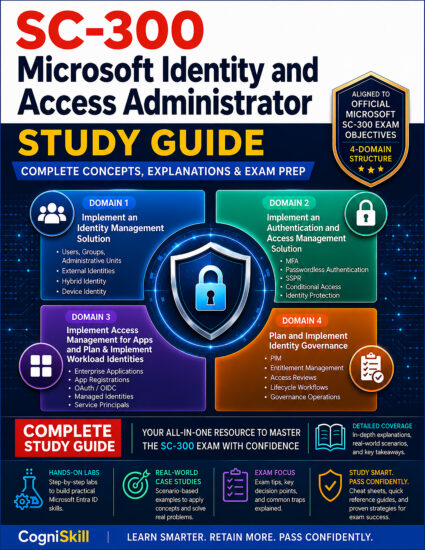
SC-300 Microsoft Identity and Access Administrator — Study Guide
For building a structured understanding of the subject.
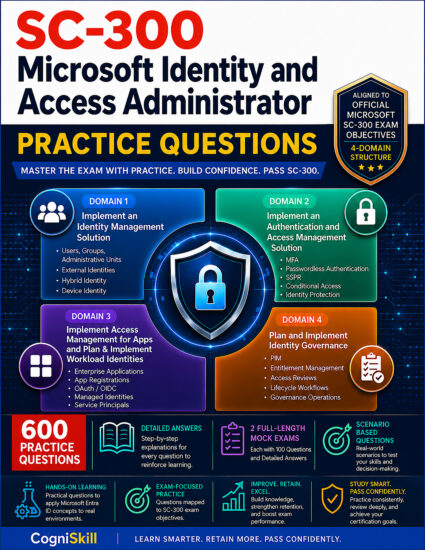
SC-300: Microsoft Identity and Access Administrator — Practice Questions
For working through questions and practical scenarios.
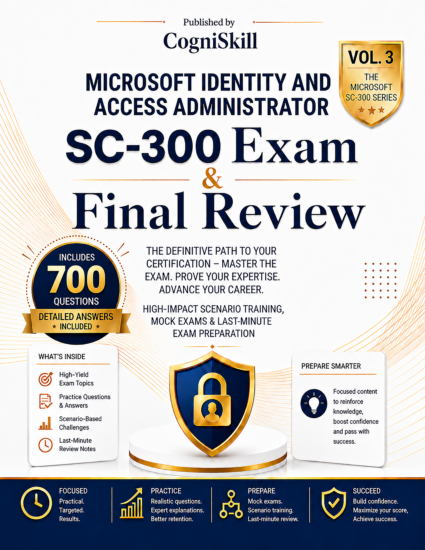
SC-300 Microsoft Identity and Access Administrator — Exam Cram & Final Review
For focused revision after you have studied the subject.
Sign in to save lesson completion. Reading position is separate from completion.
Practice notes — your working space
Save predictions, outputs and explanations as you work. Notes stay on this browser, not your account; people sharing this browser can access them. Avoid passwords and sensitive data. Export to keep a portable copy, or clear your notes before leaving a shared device.
How was this lesson?
Help us improve this lesson.